Carbon removal that can scale anywhere
Passive air contactors (no big fans), solar heat (no boilers), and modular blocks — a platform built to hit sub-$100/t and scale fast.

DAC today is slowed by high heat needs, large fans, complex plants, and land/energy friction, resulting in costs of $300–800/t. To unlock mass buyers and public programs, we need sub-$100/t.
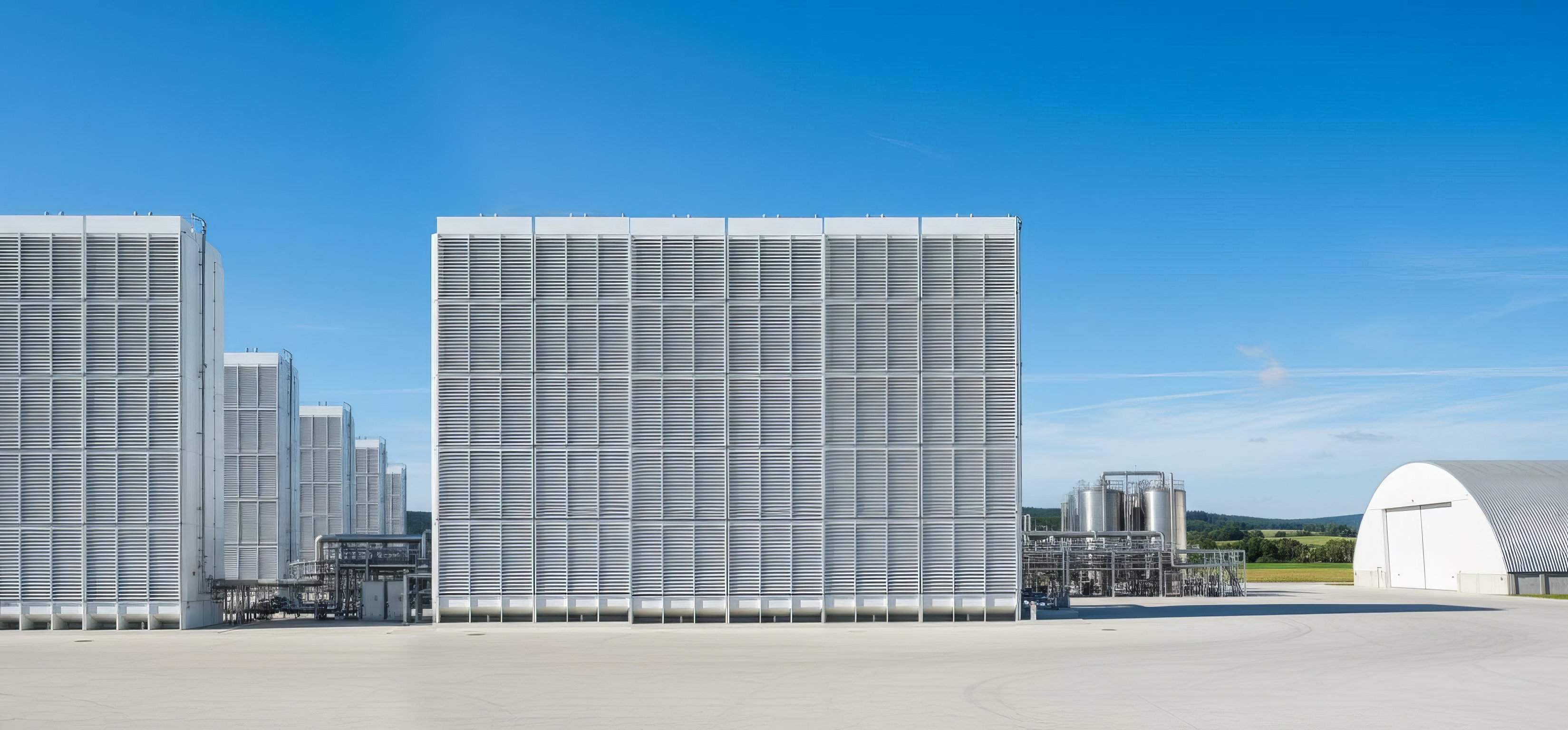
Sodium carbonate/bicarbonate chemistry with a 10×10×2 m contactor (falling-film working zone). At night a bicarbonate buffer stores CO₂; by day we regenerate.
Natural wind (~5 m/s) flows across the 10×10×2 m working zone (~500 m³/s). CO₂ reacts with sodium carbonate solution.
Buffer size ~80–100 m³ per module (2.0–2.5 M NaHCO₃) stores night capture as bicarbonate for day-time regeneration.
The same buffer lets us absorb surplus electricity to drive electro-regen or synthesize fuels — storing energy in molecules and stabilizing prices.


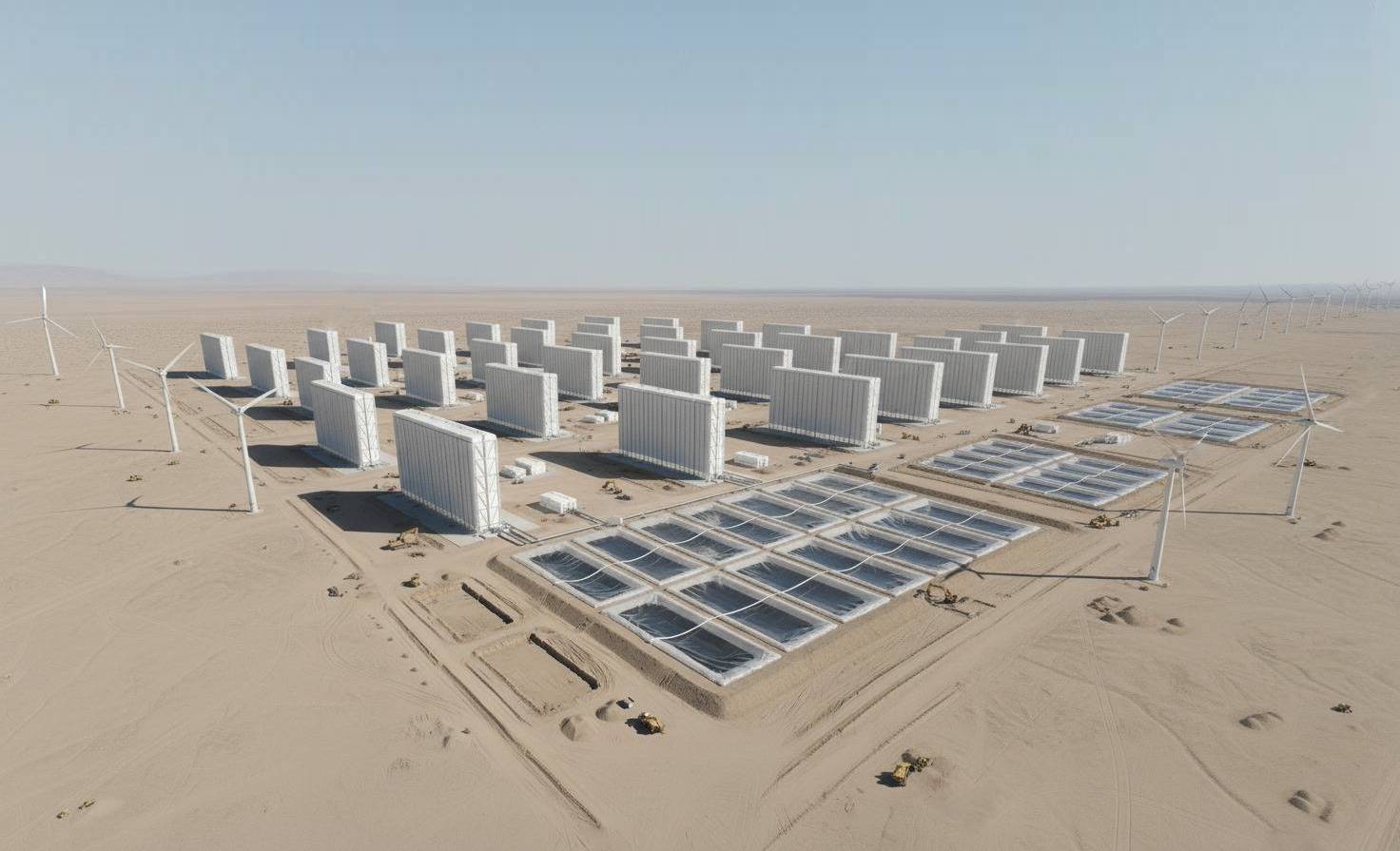
Each module uses ~1,500–1,800 m² of solar field in sunny sites. Simple films + vacuum + buffer keep CAPEX/OPEX low while maintaining throughput.
KPI 3.2–4.6 kgCO₂/m²·day • water <0.1 m³/t
Use-case: Sunny, windy regions (MENA, North Africa & Southern Europe, US Southwest).
Cost (LCOC): $93–104/t, path to $70–85/t.
Risks: Membrane life, dust. Hedged by materials testing & engineering controls.
Use-case: Ports, steel/cement plants (circular hubs).
Cost (LCOC): Often net-positive after product sales.
Risks: Logistics & feedstock quality. Hedged by supply contracts & QC.
Use-case: Nodes with cheap/negative electricity (Nordics).
Cost (LCOC): $100–160/t (power-dependent).
Risks: Higher CAPEX & price volatility. Hedged by e-fuel offtakes & grid services.

Annual operating profit (before finance & tax), assuming a mature solar-track cost base of $85/t at various carbon credit sale prices.
Buyers want high-quality, durable CO₂ removal with clear measurement. We target a 10-15% market share by 2050.
~0.5–1.5 Gt CO₂/yr of removal is needed by 2030, and ~5–10 Gt/yr by 2050 (IPCC & IEA).
At $100–200 per ton, this implies a market of ~$50–300B/yr by 2030 and ~$0.5–2.0T/yr by 2050.
High-quality, durable DAC credits are sold today for $200–$600 per ton, mainly to corporate buyers.
We supply equipment to fabricate the contactor and solar modules on-site, plus controls. Local crews can build and maintain the sites.
We provide monitoring software and reporting for high-integrity credits, verified under standards like Isometric or Puro.earth.
We offer standard contracts, safety protocols, operational training, and plan a price-floor fund to protect operators from volatility.
Material testing, solar-packet durability, MRV stack, pilot sites scoping.
1–2 KTPA multi-module farm; certification; first offtakes.
Replicable parks (10→50+ modules) based on local economics; mix tracks as needed.
If you want to invest, become a partner, or buy removals - contact us.